 |
|
 |
|
 |
||||||
Religion: |
 |
|||||
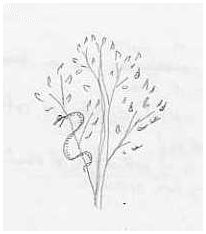
And Yahweh commanded the man, saying, "Of every tree of the garden you may freely eat, but of the tree of the knowledge of good and bad, you shall not eat of it, for in the day that you eat of it you shall surely die. Yahweh is lying. The modern Christian interpretation of the Garden of Eden is all wrong. The original story doesn't make any sense to people raised on the Greek philosophers' idea that God is perfect, so modern readers have to misinterpret it to make it square with Platonic theology. The story, however, makes perfect sense as the story of a manipulative, jealous deity. Indeed, the story comes from a time when deities were more often thought of as jealous and powerful than as good and just (see Zeus, et al). The modern misreading of the story is that the snake tricks Eve into eating the apple, and that Yahweh punishes Adam and Eve for being disobedient by, among other things, taking away the Tree of Life. The real story, however, is clear if you read it with an open mind. And Yahweh commanded the man, saying, "Of every tree of the garden you may freely eat: But of the tree of the knowledge of good and bad, you shall not eat of it: for in the day that you eat thereof you shall surely die." . . . Now the snake was subtler than any beast of the field which Yahweh had made. And he said to the woman, "Yea, has God said, 'You shall not eat of every tree of the garden'?"
And the woman said to the snake, "We may eat of the fruit of the trees of the garden: But of the fruit of the tree which is in the midst of the garden, God has said, 'You shall not eat of it, neither shall you touch it, lest you die.'"
And the snake said to the woman, "You shall not surely die: For God knows that in the day you eat of it, then your eyes shall be opened, and you shall be as gods, knowing good and bad."
And when the woman saw that the tree was good for food, and that it was pleasant to the eyes, and a tree to be desired to make one wise, she took of its fruit, and ate, and gave it also to her husband; and he ate. And the eyes of them both were opened, and they knew that they were naked; and they sewed fig leaves together, and made themselves aprons. . . . [Yahweh finds out about the tree of knowledge and curses the snake, the woman, and the man. This is the "just so" section that explains why snakes don't have legs, why women have to do what men say, why men have to labor, etc.] And Yahweh said, "Behold, the man has become as one of us, to know good and bad: and now, lest he put forth his hand, and take also of the tree of life, and eat, and live forever." Therefore Yahweh sent him forth from the garden of Eden, to till the ground from which he was taken. So he drove out the man; and he placed at the east of the garden of Eden cherubim, and a flaming sword which turned every way, to guard the way to the tree of life. First, Yahweh says that Adam and Eve shouldn't eat the fruit from the Tree of Knowledge of Good and Bad. He doesn't say, "Because I command you not to eat the fruit." He says, "Because it will kill you the very day that you eat it." That's not true, but Yahweh says so because he doesn't want humans eating the fruit and gaining understanding of good and bad. He doesn't mind them eating the Tree of Life and living forever, so long as they remain ignorant and thus inferior to him and to the other gods of the heavens. Then the snake, who's a clever creature but not Satan, tells Eve the truth about the "poisonous" fruit: it won't kill you, it will make you wise like Yahweh. She and Adam eat the fruit and they see that the snake is telling the truth. When Yahweh finds out, he's angry. Like a dysfunctional parent or pagan deity caught in a lie, he punishes Adam and Eve. Paradoxically and unfairly, he punishes them for what they did before they knew good from evil. As to the Tree of Life, he removes it from the garden not to punish Adam and Eve but because he's afraid that if they eat its fruit they'll become too powerful. As the idea of God has changed over time, the selfish, deceitful, vengeful actions of Yahweh have become unbelievable. A veil of misinterpretation has been drawn over the story, so that by the time anyone reads Genesis for themselves they've already been coached to misunderstand it. —JoT
PS: It's noteworthy that among the curses Yahweh levels against Adam and Eve, he doesn't mention that they and their descendents will spend eternity being tortured after they die. That's a lot worse than suffering during childbirth or being forced to labor for three score years and ten. Why doesn't Yahweh mention the ultimate penalty? Because it's a pagan idea not found in the Bible.
PPS: Harris, in Understanding the Bible, suggests that Yahweh not killing Man and Eve could be considered His first act of mercy. That seems like another fair assessment. (JoT, Sep 07)
PPPS: The typical phrase "good and evil" used in this story, by the way, sounds good to readers steeped in cosmic dualism, but there was no such dualism 3,000 years ago when this story was first written down. The Hebrew terms encompass prosperity and calamity. The "evil" referred to is the same sort of "evil" that Yahweh himself is willing to commit against the Iraelites when they disappoint him. It means evil in the ancient, practical sense of "destructive" or "nasty" (as in an "evil" tasting drink), not in the purified abstracted metaphyiscal sense. Here I translate the terms as "good" and "bad," the English terms that encompass both moral and practical judgments. A more lyrical translation might be "weal and woe."
Chris
Cain's Sin: another account from Gensis that confounds modern sensibilities
Samson the Terrorist: another reading of the Old Testament that fails to square with Sunday School
St. Paul was Satan's Dupe: who was that spirit of light, really?
Plato's Myth of Heaven and Hell: another example of Greek thinking in popular Christian theology
|
||||||
|
|
|
|
|
|
|